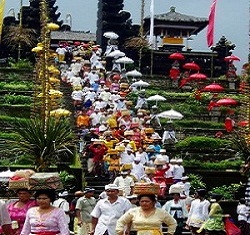
Showing posts with label Bali Interest Place To Visit. Show all posts

Taman Ayun Temple With Beautiful Garden

TAMAN AYUN TEMPLE

TAMAN AYUN TEMPLE SITUATED IN MENGWI VILLAGE WITH VERY BEAUTIFUL GARDEN INSIDE THE TEMPLE


Taman Ayun Temple

Taman Ayun Temple is situated in Mengwi Village of Badung District, around 18 km to the west of Denpasar. It is a very beautiful temple, as the name tells (Taman Ayun  means temple in a beautiful garden). In addition to its beauty, Taman Ayun Temple is also considered to have historical values, which makes the regional government of Bali suggests the UNESCO in 2002 that this temple is included in World Heritage List.

Taman Ayun Temple is a Mother Temple (Paibon) to Mengwi Kingdom. This temple was built by Mengwi King, I Gusti Agung Putu, in the Javanese year of 1556 (1634 AD). Initially, I Gusti Agung Putu built a temple to the north of Mengwi village to the worship of his ancestors. The temple was named Genter Park. When Mengwi grew into a big kingdom, I Gusti Agung Putu moved Genter Park eastward and expand the compound. The expanded temple was officially declared Taman Ayun Temple on Kliwon Tuesday - Medangsia the fourth month in the Javanese year of 1556. Until today, each Kliwon Tuesday of wuku Medangsia in Javanese calendar (Saka), a piodalan (ceremony) is held in this temple to celebrate the temple’s anniversary.

Taman Ayun Temple has gone through a number of restoration works. Large scale restoration was implemented in 1937. In 1949, restoration work was done to the kori agung (the grand room), Bentar temple. A big wantilan was also constructed during the time. The third restoration was implemented in 1972, followed by the final restoration in 1976. Taman Ayun Temple complex is 100 meters in length and 250 meters in width. The complex comprises an outer court and three inner courts. The inner courts, sided with stone fences, have different elevations, and the inner most is the highest one. 
The outer court Taman Ayun Temple, also known as Jaba, is situated at the outer side of the pool. There is a bridge over the pool to connect the outer court to the inner ones. At the end of the bridge, on the inner court side, there is a Bentar gate followed by a pathway leading to the inner courts. There are two giant statues at each end of the bridge. 

At the left side of the pathway Taman Ayun Temple, near the gate, there is some sort of a small guardhouse. Here, at the first inner court, there is a Wantilan (a sort of hall) at which some ceremonies usually take place, including a cockfight, which is also part the ritual ceremonies at the temple. There is a pathway lying across the first inner court and dividing it into two parts, connecting the gate into the first inner court to the one into the second inner court. To the southwest, there is a round gazebo at which one can have a rest and enjoy the beauty of the temple. There is a pond near the gazebo covered with water lilies. Right at the center of the pond, there is a small post that sprinkles water to nine different directions. To the east, there is a cluster of small temples called Luhuring Purnama Temples. 
There is a gate at the end of the pathway Taman Ayun Temple dividing the first inner court into two. The gate leads to the second inner court, which is situated on a higher ground than the first one. Across from the gate, on the second inner court, there is a building functioning as a partition. The partition Taman Ayun Temple decorated with relief sculpture depicting nine guardian gods of compass points.

To the east, there is a small temple called Dalem Bekak Temple. To the west, around the corner, there is a balai Kulkul with its roof rising high. The third inner court, which is also the inner most and the highest one, is the most sacred area. Its main door, which is called pintu gelung, is placed right in the middle and it is opened only during ceremonies. The main door, however,Taman Ayun Temple is flanked by two gates through which people can access the court to do daily routines at Taman Ayun Temple. The court houses several Merus, a temple, a Gedong, a Padmasana, a Padma Rong Telu, and other religious buildings.


Source : Taman Ayun Temple
Author : Bali Golden Tour

Gunung Kawi Temple With Historical Candi

GUNUNG KAWI TEMPLE

GUNUNG KAWI TEMPLE IS A TEMPLE IN MOUNTAIN OF POET WITH COLLECTION OF HISTORICAL CANDI


Gunung Kawi Temple
Bali's own Valley of the Kings is Gunung Kawi in Tampaksiring. This collection of candi is beautifully situated in a river valley surrounded by rice fields and jungle. This has been one of our favorite day trips for years.
Gunung Kawi Temple is a collection of ten candi, created to evoke the appearance of temple fronts and designed to provide residence for the souls of ancient kings. The candi are hewn into the valley walls on both sides of the Pekerisan River. The Gunung Kawi does have an interesting history. Inscriptions over each Candi approximate the date of construction to be in the 11th C. It is believed that each temple served as a memorial to a deified royalty principally because they are shaped like the burial towers, or Candi’s, found throughout Central Java. But in Java they are free standing whilst those found at Gunung Kawi are actually hewn relief's in solid rock. While the exact origin of the candi is unknown, there is evidence to suggest that the first set of five were built to honor King Anak Wungsu, whose rule over central and east Bali extended from AD 1050 to about AD 1080. It is possible that one was built for him and the other four for his wives, who would have ceremonially committed suicide after his death

Gunung Kawi is two rows of ancient royal tombs on the banks of the Pakerisan River deep in a ravine overlooked by terraced rice-fields. The holy Pakersian River flows through the centre of Gunung Kawi cutting the site into two separate sections with a bridge to connect one side to the other. It is believed the holy waters of the Pakerisan sanctify Gunung Kawi, and the beauty of the place evokes a relaxing and peaceful atmosphere.

On the east side of the river are situated five candi which constitute the main group in this complex. Across the bridge are four candi on the west side. The remaining candi at the southern end is often referred to as the ‘tenth tomb’. At the bottom of the stairway and to your right-hand side through a small field (about one kilometer) is where the tenth tomb is located. The legend to this amazing place is intriguing. It is believed that the mythical giant Kebo Iwo carved out all of the ancient tombs in one night with his fingernails. There are 3 temples which so called the name as Gunung Kawi in Bali those are Gunung Kawi in Sebatu countryside, Gunung Kawi Temple in Keliki countryside and Gunung Kawi Temple in Babitra countryside. Behind the small temple you can find a couple of meditation caves, which indicates that this is a pre-Hindu place where monks and pilgrims came together to meditate.

Gunung Kawi is located near Tampak Siring village, around 5 km from well known Tirta Empul Temple. The location is 35 km from Denpasar, city, 50 km from Kuta, and 68 km from Nusa Dua. It is still one route from Gowa Gajah, Pura Pusering Jagat, Gunung Kawi, and Tirta Empul temple. This area preserves many ancient sites, stone sculptures and rock cut structures, especially along the slope of Pakerisan river. The site of Gunung Kawi is reachable only by foot from the parking area, passing elevating slope of the river with more then 100 steps down and up the river. It is just after the village of Pejeng, a village full with ancient remains of ancient stone sculptures, and even the oldest historical fact on Buddhism is found also around this village. Today due to the rich contains in historical fact a museum has been built before the village of Pejeng, near the temple of Kebo Edan. Within the village of Pejeng to mention a few of them there are some temples with ancient heritages such as Pura Pusering Jagat, Pura Rejuna Metapa, Pura Kebo Edan, Pura Samuan Tiga, Pura Bedugul Kana, and still many other smaller temples that preserves the ancient stone sculptures. Pejeng is a real historical museum.

If we see from the name we know today, it might be the possibility of translation Mountain as a Gunung and Kawi as poet, so gunung Kawi can be meant the mountain of poet. The river that forms the ravine which slope is cut for the temple is Pakerisan river, kris means Balinese long blade or knife. What is actually referred by the name is not clear until now. The people today consider this complex as part of a temple which was constructed much later time. See from the history it is not part of a temple in the meaning of worshipping the Hindu God, but having the relation with personal deification of a king. The whole complex consist of 5 smaller complexes, and including the temple are 6 complexes. Two complexes at the east slope of the river and 3 complexes are on the west slope. Two complexes facing each other separated by the river are identified as belong to the king and his Queen or concubines. 

The complex for the king consist of 3 rock cut candis and the complex for the Queen consist of 4 rock cut candis. It is hard to understand that only the candi for the king made in 3. It might be the king was with his 2 principal consorts, and the 4 candis across the river were only for his other concubines. At the door of the candi for the king is mentioned in a inscription of the king died at Jalu. Jalu can mean kris or taji, a sharp small blade armed for the cock fighting. 

Who was the king monumentalized here? is un-answered question until now, except based on highly decorative writing of inscription called "Quadrangular Kadiri writing style" The influence of Kadiri kingdom to Bali was only arrived around 1227 AD under the king Kertanegara. While the date carved at the stone sculpture on Mount Panulisan with the same style mentioned the dates 1011 AD, 1074 AD, and 1077 AD. While the period between 989 AD to 1001 AD was the rule of king Udayana Warmadewa with his Queen Mahendradatta. In their charters it is mentioned that king Udayana was deified at "Banyu Wka", and his Queen Mahendradatta was deified at Buruan which is already identified, and only Banyu Wka is not identifiable until today, and archaeologists supposed that Banyu Wka is Gunung Kawi, as Banyu means water, and Wka means clear or clean, so he must have been deified at a river with very clean water, yet an ancient monument just renovated is Pura Mangening which also refers the name of ening or clear. The problem is the complex of the temple is not big, only one stone shrines with small zone. If we compared with his Queen monument in Buruan it makes sense that the king would not need big complex to commemorate himself. 

So who was monumentalized at Gunung Kawi? Some archaeologists believed that was the son of Udayana, either king Marakata Pangkajasthana or Anak Wungsu. The rule of Marakata is not known much and there is not many record about his government. Different from Anak Wungsu who issued many inscriptions and he was a diligent king in making every records which lead an idea that he was a great king just like his father king Udayana. With the length of time of ruling that was from 1049 AD to 1077 AD can be a proof that during his rule the condition of the society was good, and it was not impossible he was respected by their whole people. As the fact of many great king in Indonesia that commemoration with candi or sculpture was a normal way the people to honor their king who was able to bring the welfare for the society. In this case writer wish to believe that Gunung Kawi has been dedicated for the great name of king Anak Wungsu.


Source : Gunung Kawi Temple
Author : Bali Golden Tour

Rambut Siwi Temple is A Temple With Sage Hair

RAMBUT SIWI TEMPLE

RAMBUT SIWI TEMPLE IS A TEMPLE CONTAIN OF A RELIC WHICH LOCK OF SAGE HAIR THAT IS VENERATED

Rambut Siwi Temple

Rambut Siwi Temple is located in Jembrana regency, east of Yeh Embang village, Mendoyo district. It is about 10 km from Negara and can reach by any cars or motorcycles as well. Local peoples believe that they have to worshipped this temple to get a God bless of securing during the Journey. The Main temple located in cliff bank and and blessed by the breath taking view of the Indian ocean. This temples owns the representative temple building which is set beside main road of Denpasar to Gilimanuk. Name of Rambut Siwi is contain of a relic which is a lock of sage’s hair (rambut) that is venerated (siwi).

History of Rambut Siwi temple itself, it is about when Danghyang Niratha frist arrived from Java from traveling to the west, on his way to present himself to King of Gelgel, he heard a terible epidemic in Gading Wani village, Danghyang Nirata went there and heal the disease. The grateful villager s begged him to stay and settle there but Danghyang Niratha remember that he have to present himself to Gelgel, and he left them a lock of his hair as a protective token. And since that Danghyang Niratha was given the honorific name “Pedanda sakti Wawu Rawuh” means “The newly arrived powerful high priest”

The Rambut Siwi Temple is one of the biggest of all the Hindu temples in Bali and is located in the Negara regency in the west of Bali. Situated about 2 hours away from Denpasar in the further western areas where the atmosphere is classically Balinese with un-spoilt tropical woodlands and small villages spread out around the coast with a few larger areas inland. Most of this area is the conservational park of Bali which is home to many of the islands endemic species that are now protected in the hope of re-sustaining the entire island.
Located right the beach the Rambut Siwi Temple is very photogenic and is extremely beautiful with the main shrine set in to the cliff. As with many of the Balinese temples, the recorded history of the Rambut Siwi Temple is unsure and sparse although the locals maintain that the temple is one of the water temples was built in order to keep the powerful forces of the sea away from the land and the village. Rambut Siwi Temple is the location of many ceremonies and activities in the Balinese Hindu calendar and the family calendars of the local families such as birth and marriage ceremonies.

The locals also believe that the Rambut Siwi Temple is a secret temple, today it is difficult to spot and it is said that there was a time when the temple was secret and held many secret objects and is shrouded with mystery and uncertainty to this day. this certainly adds to the charm of the Rambut Siwi Temple and is one of the reasons that its tucked away and yet grand statue is so impressive and yet humble. Another use of this temple is for the blessing of the journey that is made when traveling in these parts as often the passing of the Rambut Siwi Temple is on a long journey. There are other temples that are used in similar ways but many locals can be seen stopping at the Rambut Siwi Temple for a short time in order to ensure that their journey will be safe one heading either further north or back to the south of Bali. The views in this are sensational ether looking towards the sea and down over the temple or from the beach looking up to the temple and over the tropical woodland that surrounds it.

The gardens include extremely well kept tropical flowers and trees presented in classic Traditional Balinese styles and maintained with a great amount of care. Visiting the Rambut Siwi Temple is cheap and a very beautiful way to spend part of your day in this area, particularly at sunset when it is at its most beautiful. The Rambut Siwi Temple is a far less crowded alternative to the Tanah Lot temple that is the most visited temple in Bali and the most Photographed of all the places in Bali. However you have to be willing to make the longer journey to enjoy the Rambut Siwi Temple's serenity.


Source : Rambut Siwi Temple
Author : Bali Golden Tour

Tirta Empul Temple is Sacred Spring Water Located Beside President Palace at Tampaksiring

TIRTA EMPUL TEMPLE

TIRTA EMPUL TEMPLE IS BALINESE HINDU TEMPLE AT TAMPAKSIRING VILLAGE, THE TEMPLE HAVE A SPRING WATER IS USED AS THE HOLY WATER FOR VARIOUS RELIGIOUS CEREMONY AT TIRTA EMPUL TEMPLE


Tirta Empul Temple is built around the sacred spring at Tampak Siring. For more than a thousand years, Balinese worshipers have been drawn to Tirta Empul Temple whose sacred spring is said to have been created by Indra and to have curative properties. The tradition continues almost unchanged at the temple today.Over 1000 years old, the temple and its two bathing places have been used by the people for good health and prosperity because of the spring water's curative powers.

Tirta Empul Temple It is a myth described on a manuscript called Usana Bali says that a Balinese arrogant king named Maya Denawa did not believe in god, and objected the people to worship god. Later the punishment for the king came. The warior of Bhatara Indra arrived to attack Maya Denawa and put him away from the throne. But Maya Denawa used chemical weapons causing all the warriors of Bhatara Indra were poisoned to dead. Seeing this Bhatara Indra than planted his pole to the earth, and sprang water. This water was used to spray the dead warriors, and they alive back. So this water source until now is believed to be the source of life and prosperity. It is especially correct if we associate this water spring with the irrigation system around the area, as it gives hundreds of hectares of rice field from Tampaksiring until Pejeng areas.

The inscription mentions the construction of Tirta Empul Temple in 960 AD, when the king Chandrabhaya Singha Warmadewa ordered this which is already 1042 years ago. It seems that this place was not interesting for ancient king but on 1954 the first Indonesian president Soekarno had built his presidential villas just at the west side of the temple. Originally a residence for Dutch officials, it was later used by former President Soekarno during his frequent trips to Bali. This villa has brought also the name of Tampaksiring become known world widely.

The present temple as a common temple of Bali, the layout is divided into 3 courtyards. At the middle courtyard is constructed and first courtyards were constructed:
  1. Pool with 13 fountains, used as holy water for cremation or dead ceremony,
  2. Pool with 8 fountains, used as water for symbolic cleaning ( spiritual purification ), when a person is sick it is believed he is infected by immaterial dirt.
  3. Pool with 5 fountains for holy water used people from outside come to pray.

At the first courtyard is also a pool for public bathing place. Total number of shrines at Tirta Empul Temple are 30 nits currently, after later addition by local people who have the responsibility for the temple. The ceremony is performed every 210 days, and fixed date can be read in Balinese calendar.
There is an old stone sculpture being preserved at the last courtyard of the Tirta Empul Temple in the form of buffalo. The condition of the carving is badly damage, so it can not be observed in detail to fix the type. Buffalo in the pantheon of Hindu is considered as the mount of god Shiwa and this animal is called ” Nandi

The name "Tirta Empul" signifies a crystal clear stream which is used as the holy water for various religious ceremony. Visitors are allowed only up to the main courtyard. From here, one could enjoy the twin shrines and split gate, common in most temples in Bali. Inside the inner sanctum, there are a number of bathing pools for the Hindus.
The Tirta Empul Temple includes the traditional Balinese split gate along with shrines to Shiva, Vishnu, Braham, Mt. Batur, and Indra. There is also a large open pavilion in the main courtyard, useful for relaxing in the shade.

But the main attraction at Tirta Empul Temple is a long rectangular pool carved of stone, filled with koi and fed by the sacred spring via 12 fountains. Worshippers first make an offering at the temple, then climb into the main pool to bathe and pray. Many collect the holy water in bottles to take home. Nearby there are two smaller pools fed by the spring.
Tirta Empul Temple is located in the village of Tampak Siring, accessible by public transportation from Ubud. The souvenir stands outside the temple specialize in the local craft, carved bone jewelry.


Source : Tirta Empul Temple
Author : Bali Golden Tour

Ulun Danu Temple is Beautiful Floating Temple in Beratan lake

ULUN DANU TEMPLE

ULUN DANU TEMPLE IS DEDICATED TO THE GODDESS OF THE LAKE IS IDA BATARI ULUN DANU ON THE EDGE OF A HUGE CRATER


Ulun Danu Beratan Temple


Ulun Danu Beratan Temple, a temple dedicated to the goddess of the lake is Ida Batari Dewi Ulun Danu on the edge of a huge crater. The dominant shrines are Meru’s (pagodas) dedicated to the lake goddess and the gods of Mount Batur and Mount Agung, the largest volcano in Bali. The temple was built in the 17th century in worship of the main Hindu trinity, Brahma-Vishnu-Shiva, as well as the lake goddess, Dewi Danu. The sight and cool atmosphere of the Bali uplands have made the lake and this temple a favourite sightseeing and recreational spot as well as a frequently photographed site. Ulun Danu Beratan Temple, literally ‘the source temple of Lake Beratan’, is easily the island’s most iconic sanctuary sharing the scenic qualities with the seaside temples of Uluwatu Temple and Tanah Lot temple. The smooth reflective surface of the lake surrounding most of the temple’s base creates a unique floating impression, while the mountain range of the Bedugul region encircling the lake provides the temple with a scenic backdrop.

Ulun Danu Beratan Temple mostly called as a Ulun Danu Temple but not to be confused with Ulun Danu Batur Temple, which is on the rim of the caldera at Batur Lake. It is especially important for the Balinese. Only here can you get holy water of a particular variety. The water is collected from the lake itself, directly in front of the temple. Visitors have to wear a sash and not go near. Bathing is forbidden. The lake is the ultimate source of water for the rivers and springs that irrigate central Bali. It is therefore of the utmost importance. The temple priests say that the lake is fed by springs located at each of the wind directions. Each of the springs is the origin of water for that particular region of central Bali. So, farmers from North Bali collect their holy water from the northern spring of the lake and so on. Ulun Danu Temple lies by the western banks of Lake Bratan in the Bedugul Highlands at a level of 1239m, is one of the most picturesque and most photographed temples in Bali. Ulun Danu is inside the caldera of the now extinct volcano Gunung Catur. It is one of the main sources of irrigation in the Balinese highlands, and so the temple is dedicated to Dewi Danu, the lake goddess.

Ulun Danu temple can be traced back to the rise of the Mengwi kingdom. The name of Ulun Danu Beratan Temple is taken from the lake where the temple is built at Beratan Lake. The name of Beratan Lake is inseparable with the Beratan Mount as Deity and Goddess as fertility source, prosperity to keep the prosperity in life and society life. In Papyrus Chronicle of the Mengwi is elaborated by the history of Ulun Danu Beratan Temple founding together with existence of the Mengwi Empire. Therefore its status is pertained with the secondhand of Temple Empire what is usually pertained as Dang Kahyangan. It is the same to the description in papyrus of Usana Bali and Padma Bhuwana, hence Puncak Mangu Temple where the Panyawangan (representative place to worship) is the Ulun Danu Beratan Temple. So it is called by entire Balinese residents as Kahyangan Jagat (The Biggest Group of Hindu Temple in Bali )

The ‘floating’ temple complex is comprised of four groups of shrines, including the prominent Lingga Petak shrine to its east. There are four gates facing each of the four points of the compass.
Ulun Danu Beratan Temple is consisted of 4 temples complex that are:
  • Lingga Petak Temple owns the function to worship the Siwa God
  • Penataran Pucak Mangu Temple is referred this gate as Parhyangan ri pinggiring rawa Beratan or Danu Beratan Temple is founded by I Gusti Agung Putu to worship the Hyang ing Parwata or Deity which is placed in Pucak Mangu that is Bhatara Hyang Danawa as according to papyrus of Padma Bhuwana and Usana Bali, because Mangu Mount is located in north direction, hence it is called the Bhatara Hyang Danawa or Wisnu God
  • Terate Bang Temple is functioning to worship of Brahma God
  • Dalem Purwa Temple is functioning to worship of Danu Goddess which is considered to be miraculous of the Bhatara Hyang Danawa or Laksmi Goddess.


The temple ceremony execution at Ulun Danu Beratan Temple is consisted of two types those are:
  • The temple ceremony which is executed every six-month (210 days) that on Anggara (Tuesday) Kliwon Julungwangi (Base on Balinese Hindu calendar). Every 12 months (420 days) is executed by the bigger ceremony from the ordinary ceremony, so-called Piodalan Agung
  • Pakelem ceremony is executed at any times as according to situation and condition. The Pakelem ceremony owns the function to worship the supremacy and also cheapness of the infinite for award of life, fertility, prosperity, as impact of the existence of ecosystem balance so that give the benefit for life and universe life forever and ever, during Beratan Lake and Beratan Mount stand up


Source : Ulun Danu Temple
Author : Bali Golden Tour

Goa Lawah Temple with Thousand of Bats In The Cave

GOA LAWAH TEMPLE

GOA LAWAH TEMPLE IS A TEMPLE WITH NATURE CAVE DWELT BY THOUSANDS OF TAIL BAT


Goa Lawah or Bat Cave is one of favorite places of interest in Bali and it is located near of hilly bank so it is called reef of Middle hill. This cave is located in Pasinggahan countryside, Dawan sub district, Klungkung Regency, east part of Bali and about 1,5 hours from Denpasar Town. There is a nature cave dwelt by thousands of tail bat located at north side from Jeroan/center of Goa Lawah Temple . Meanwhile the main road from Klungkung to Amlapura is just in front of the temple. This cave is apposite to the beautiful beach with black sand along the coastal area.

Goa Lawah Temple, a shrine for Balinese Hindu
Pursuant to the papyrus of Dwi Jendra Tattwa, the Goa Lawah's name is Goa Lelawah, the name which is given by Danghyang Nirartha (a priest overspread the Hindu teaching in Bali) when he stop in this place on his Tirtha Yatra trips. He arrive at a cave which is a lot of bats hang on and its unbroken voice clamor as hymn to add the beauty of the cave. Therefore this cave is named by Goa Lawah or Bat Cave. On the above cave is growth by the flower trees with it's smelt fragrance and stimulus the peace mind of Danghyang Nirartha, so that he overnight stay for some nights in this place. From the cave we see also the beautiful coast with the blue ocean with Nusa Penida Island as a backdrop.

Goa Lawah Temple History
According to the chronicle of Bendesa Mas, it mentions that the elaborations of Mpu Kuturan (a Hindu priest who come from Java) then he live in Bali which has been hosted in Silayukti, Padang Bai. He also builds some temple like Goa Lawah TempleAccording to the Papyrus of Dwijendra Tattwa, it narrates that after Danghyang Nirartha stay some nights at Goa Lawah, then he build a Kahyangan Temple on the ground. It means that Danghyang Nirartha extends the Palinggih or temple building existing at Goa Lawah Temple .Bali tourist attraction is a cave located on the beach called Beach Kusamba, at the mouth of the cave there is a temple named Pura Goa Lawah (Goa Lawah Temple).
Goa Lawah very interesting to visit because of strategic location off the coast with views of sea and island of Nusa Penida in the distance and the arrangement of beautiful beaches. On the beach sometimes tourists can witness traditional ceremonies and activities can also see bats hanging from the edge of the cave. Bali tourist attraction makes this one worth your visit with your family during the holidays to Bali

Location Goa Lawah Temple :
Goa Lawah Klungkung located in approximately 1 hour drive from Denpasar City or 4 miles from the center of Semarapura which is the district capital Klungkung.

History Goa Lawah Temple :
In Goa Lawah consists of two syllables of the cave, which means Cave and Lawah which means bat cave where Lawah tail inhabited by thousands of bats in the mouth of this Bali attractions there is a temple Khayangan Jagat status. Goa Lawah Temple is a sacred and beautiful area. There was a blend of sea and mountains (linga-yoni). As the name suggests, this temple there is a cave inhabited by thousands of bats. While at the mouth of the cave there are several palinggih Stana of the Gods. In the yard, also stood firm several Meru and other sthana. Narrated MPU Kuturan come to Bali during the tenth century the government-led Children's Youngest brother of King Airlangga. Airlangga own rule in East Java (1019-1042). When he arrived, mpu Kuturan find many sects in Bali. Seeing the fact that, mpu Kuturan then develop the concept of Tri Murti with the aim of uniting all these sects Kuturan MPU also teaches making heaven Pakraman Three in every village in Bali as well as confirmed the presence of Jagat heaven that one of them is Goa Lawah.


Source : Goa Lawah Temple
Author : Bali Golden Tour

Goa Gajah Temple with Ganesha Statue

GOA GAJAH TEMPLE

GOA GAJAH TEMPLE IS A BUDDHIST TEMPLE OR HERMITAGE FOR BUDDHIST MONK

Goa Gajah or Elephant Cave
Welcome to Goa Gajah or Elephant Cave which is located in west side of Bedulu countryside, Blah Batuh Sub district and Gianyar Regency. It is about 27 km from Denpasar town. This cave is built at crevasse edge from the federation of 2 rills that is called Pangkung River , where the irrigation is mixed with Petanu River flow. The federation area of two rivers is called Campuhan/Mixture. It owns the magical energy on the basis of Rwabineda Concept/two different matters on this basic concept hence Goa Gajah (Elephant Cave) is intentionally built among two rivers. 

The word of Goa Gajah is anticipated coming from the word of Lwa Gajah, the name of Buddhist Temple or hermitage for Buddhist monk. The Goa Gajah's name is written on Negara Kertagama papyrus which is compiled by Mpu Prapanca on 1365 M. Lwa or Lwah/Loh mean the river and it reflect to the meaning that the hermitage is located at Gajah River or in Air Gajah. In the year inscription 944 Saka, it is mentioned with the name of ‘ser ring Air Gajah' that is meaning the Subak leader in Air Gajah. The word has mentioned that the hermitage of Lwa Gajah is located in Subak Air Gajah. Among the local residents, the Goa Gajah Temple  is better known as Cave Temple, located in the west of Bedahulu Village, Blahbatuh Subdistrict, Gianyar Regency. It is about 27 km east of Denpasar. A visit to this temple can be done easily because it is only a few feet below the highway toward the village of Tampaksiring Indeed this temple was built at the valley of Petanu River having beautiful natural panorama. Goa Gajah was rediscovered in 1923 and in 1954 was rediscovered the bathing pond in front of the cave followed by the restoration and re-installation of the shower areas that originally located in front of the cave where its condition was incomplete.

In the northern part of the temple, lies a carved Cave of Nature in the shape of  the letter ”T”. Inside this cave there is a Ganesha statue considered as the god of sciences. Additionally, at the location can also be encountered some fragments of statues and a Trilangga surrounded by eight small phallus.
In the cave wall, there are niches of the hermitage and the face of Cave is decorated with carvings depicting a jungle with its contents. Similarly, there is a short inscription which reads ”Kumon” and ”Sahywangsa”, which according to the type of letters it is alleged to originate in the eleventh  century AD .

Meanwhile in the west of the cave, there is a building retaining a squating statue inside, and the Ganesha as well as Men Brayut statue. The latter in Buddhist mythology is known as Hariti, the savior of children.In front of the cave, except for the guard statues, there are also fragments of building whose origin was unknown such as the building fragments that now being gathered in the temple’s courtyard located in the west of bathing pond. Fountain statues that have worked again in the holy bathing pond are divided into three parts and in terms of its style, they are probably derived from the eleventh century AD. Unfortunately, the statue fountain located in the middle of the pond, has not been found until now.

Goa Gajah Temple occur two Buddha statues, one of them is without head while another is still good enough with the style of Central Java. The north side of this statue seemingly stay to stick on the cliffs, where the foot of the cliff temple has long fallen into the creek. On the side of this small can be found three-pronged relief of stupa and the ruins of the cliff temple having beautiful carvings.

Based on archeological findings as mentioned above, it can be known the Goa Gajah Temple is derived from the ninth to eleventh centuries AD. In the past, it served as a monastery of Buddhist monk and Shivite priest. This conservatism also shows the unification of Buddhism and Shiva went well. For tourists who would like to visit to Goa Gajah Temple are required to wear a scarf  or sarong because other than functioning as archaeological attractions, this temple also poses a sacred place or sanctum. Sarongs and scarves are available at the location.


Source : Goa Gajah Temple
Author : Bali Golden Tour

Batukaru Temple is A Temple Located In The Foot of Mount Batu Karu

BATU KARU TEMPLE

BATU KARU TEMPLE IS A TEMPLE LOCATED IN THE FOOT OF MOUNT BATUKARU

Watukaru or Batukaru Temple is one of the biggest Hindu Temples in Bali (Sad Kahyangan) with Catur Lokapala Temple and Padmabhuwana Temple status. It is set in the plateau area with lush tropical rain forest surround it. It is situated in the peaceful area which is far from the local resident that is ideally for worship. There are some temple building spread out through the tranquility of rain forest and the big mountain of Batukaru as a back drop.


Luhur Watukaru or Batukaru Temple is located at Wangaya Gede countryside, Penebel District and Tabanan regency, and west part of Bali Island. It is located right on the foot of Mount Batukaru and about 1.30 hours from Denpasar Airport.

The history of Batu Karu temple is difficult to be found out even in the ancient omission exists in this temple. For example some profile area like harpoon own the Ancient Bali type, but no written data found it. The effort study and research of this temple history remain to find difficulties. The temple festival at Luwur Watukaru or Batukaru Temple is executed every six-month or 210 days which is every Thursday Umanis Wara Dungulan (Balinese Calendar), just the day after Galungan Day (the biggest Balinese Hindu Holidays). The extension day of temple festival is executed during eleven day, to give the opportunity for Hindu public society especially in Bali to come for praying. Pengempon (the society who take care of the temple) has the obligation to take care of the temple inclusive of ceremony execution. This fact is one of characteristic power outside of physical of Watu Karu Temple. In 1959 the temple was rebuilt from the remnants and step by step until 1977 to reach the present architectural condition. Now the temple is maintained by 2 perbekelans. A perbekelan is a unit of local administrative area consists of many Banjars. While banjar is the smallest unit of Balinese settlement group. Those 2 perbekelans are perbekelan of Wangaya Gede, located very close to the temple, and perbekelan Tengkudak. These 2 areas are responsible for maintenance, organizing the ceremonies, and various activities scheduled to be performed at the temple. Since the temple is one of the Sad Kahyangan in Bali, during the ceremony will be very crowded, full of cars, motor bikes, and people. It is suggested that during the ceremony not to have trip to this temple unless you are ready to walk for kilometers, even some time up to Wangaya Gede village.

One uniqueness in batu karu temple is the ceremony which is only last for one day, quiet different from the rest of the temple in Bali which have the average ritual duration at least 3 days. The main ceremony will fall between Galungan and Kuningan holiday in Bali, while Galungan and Kuningan is the biggest holiday for all Bali except north Bali and villages called Bali Aga. The second uniqueness is that the accomplishment of the ceremony has never been involving Brahmana priest, it is enough conducted by local priests called pemangku.

Kubayan is commissioned holy occupation lead the temple ceremony and his status higher than all priests in Pretending pertinent Ancient. In the execution of praying during the temple festival or the certain day ceremony, it has to be preceded by doing pray in Beji Temple which is located in eastside of Batu Karu Temple or inside of Madya Mandala (middle area) and Nista Mandala (outside area). After doing pray in Beji Temple, then the praying is continued in the main temple building located in the center of temple area. This is also not need again clean the hand and gargle because, it has been conducted the hallowing of body by conducting pray in Beji Temple. This is specification of praying procession in Batukaru Temple.

The three elements temple area of Watukaru or Batukaru is equal to other temples in Bali generally which is consisted of :

  1. Outside area (Nista Mandala)
  2. Middle area (Madya mandala)
  3. Center area (Utama Mandala)

After refurbishing three temples are of this temple in some years ago, the element conception and structure of these three temple areas are progressively become everlasting and conceptual. This is especially in outside area where we can meet the existence of Wantilan building (Meeting Hall) which can be used for multifunction and it is located on the right of the entrance gate. 
The refurbishment at the parking area has made easy for the Hindu society or all tourists who pay a visit to this temple. It is also other public facilities like toilet which is located at outside temple area or the left side of entrance gate is in good condition and cleans enough. 


Source : Batukaru Temple
Author : Bali Golden Tour

Besakih Temple is The Biggest Hindu Temple in Bali islands

BESAKIH TEMPLE

BESAKIH TEMPLE IS THE BIGGEST HINDU TEMPLE AND ALSO AS A MOTHER TEMPLES IN THE ISLAND OF BALI

Besakih Temple is the biggest Hindu temple in Bali which the local people call Pura Besakih. It owns beautiful view from the top of temple area where we can see the wide nature panorama until to the ocean so that way this temple is many visited by tourists from all over the world. Besakih Temple is located in Besakih countryside, Rendang sub district, Karangasem regency, east part of the island. It is located in southwest side bevel of mount Agung, the biggest mounts in Bali. It is because pursuant to Agung Mount confidence is holiest and highest mount in Bali Island.

Bali’s “mother temple”,Besakih temple, is over 900 metres up the slopes of Gunung Agung. It has been regarded as a holy place since pre-historic times in Bali. The first recorded mention of its existence is from an inscription that dates from 1007 A.D. Since the Gelgel dynasty of the fifteenth century it has been regarded as a central, holy temple for the entire island.
All the allegiances of the Balinese people come together at Besakih. Each regency has its own temple within the over-all compound, as do each of the caste groups. There is a total of 18 separate sanctuaries. The three main temples are : Pura Penataran Agung, Dedicated to Sang Hyang Widi Wasa : Pura Kiduling Kreteg, dedicated to Brahma; and Pura Batu Madeg, dedicated to Wisnu.
To the Balinese a visit to the temple sanctuaries at Besakih temple is a special pilgrimage. Each temple has its own odalan, or anniversary celebration, and on the full moon of the Balinese month “Kedasa” the entire compound of Besakih celebrates the visit of the gods, with an enormous throng of visiting pilgrims.

The Besakih's name is come from the word of Basuki, the old language from Sanskrit Wasuki, and then it become the Ancient Java Language. In this Sanskrit, the Basuki means congratulation. In mythology of Samudramanthana has mentioned that Basuki is a dragon that twines the Mount Mandara. The omission has come from tradition megalithic which had been indicated that it had to be sanctified place. It seems, the Besakih temple is coming from very old era which is far before the existence of Hinduism influence. Hereinafter, an Ancient Bali king of Sri Kesari Warmadewa found the Merajan Selonding Temple in this temple complex area. He also commands to build the Blanjong Monument that is located in Sanur Village. The Besakih Temple complex is built pursuant to cosmos balance. It is based on the nature conception which is disseminating the fundamental temple complex that is arranged to pursuant of the way direction. So, this building can deputize nature as symbolic of the world balance existence.

As we familiarize, that the point direction way like East, South, West, North, and middle as center point and each direction is named by Mandala. In Hindu philosophy, Panca Dewata is manifestation of Siwa God. Like Penataran Agung Temple as center, we find in its courtyard conception show the solidarity conception between the original Indonesia culture namely tradition megalithic in form of Punden Berundak-undak with the Hinduism concept. The ancient omissions which is existing in Besakih Temple complex can be classified into 2 types those are omission pertained by megalithic tradition and classic era. Besakih Temple beside as the altar for Hindu people in Bali, it is also as tourist destination which is a lot of visited by tourists.


Source : Besakih Temple
Author : Bali Golden Tour

Batuan Temple is Beautiful Temple in Batuan Countryside

BATUAN TEMPLE

BATUAN TEMPLE IS HINDU TEMPLE IN BATUAN VILLAGE, THE TEMPLE WAS DESIGNED VERY BEAUTIFUL WITH FULL OF BALINESE ORNAMENTS


Batuan Temple is a local Balinese Hindu temple looked after by the local resident of Batuan countryside. The temple is designed very beautiful with full of Balinese ornaments and the roof temple building is made from the fiber of chromatic black palm tree. It is strategically located beside of the main road from Denpasar to Ubud. For over a thousand years, Batuan has been a village of artists and craftsmen, old legends and mysterious tales.Batuan Temple were founded in the year 944 isaka (1020 AD). Nearly 1000 years old. The Batuan Temple is a Puseh Temple category based on the concept of “Tri Kahyangan or Tri Murti” taught by Mpu Kuturan around the 10th century to the Balinese Hindu community at the time. 

Tri Kahyangan or Tri Murti including 3 temples : 
  • Desa or Village Temple as a place to worship of God Brahma (the Creator)
  • Puseh Temple  to worship of God Vishnu (the Preserver)
  • Dalem Temple  to worship of Lord Shiva (the Destroyer)

The name "Batuan" or "Baturan" mentioned here prompts villagers to joke about being "tough as stone" or "eating rocks" as batu means "stone" in Balinese. But it likely refers to an ancient megalithic tradition in which standing stones served as meeting places and ceremonial sites for the worship of ancestral spirits. Because Batuan became a center from which Buddhist priests and brahmans spread to the main court centers of south Bali, the village has an unusual preponderance of brahman.
Local people are very concern about the care and preservation of the temple architecture and its environment. Not all existing buildings were old buildings here, there are some that have undergone renovation, renewal, and change from 10th century to 13th century and also 18th century AD. The structure and foundation of this temple are very tough and strong. It has the original Balinese ornament that beautifully craved on every building at this temple area. Some ornaments are reflection of The Ramayana Epic story and every holy building has different function philosophically.

  • At temple parking area, there is standing an ancient building called Wantilan, this place use as a meeting hall and to practice any kind of Balinese dances as Gambuh Dance, Pendet Dance, etc. Before you enter the temple there is some local people at Wantilan will lend you ‘kamben’ (a traditional Balinese costume). It is a must for you to wear ‘Balinese kamben’ to show your respect and honor about the holiness of “Puseh Temple of Batuan Village”. It’s all free, you won’t be charged for entrance. However, the local people expect every tourist who visited to this temple can donate in any amount of money to support the maintenance of the temple. There is provided a simple donation box. Every donation that you give should be based on a sense of sincerity, where Balinese people know it is called “medana punia”. 
  • In the middle yard of temple there is a long building / bale called the Bale Agung and Bale Kulkul (a gong mad by wood or bamboo).In this yard there is also a high entrance Balinese Gate called the Kori Agung, which is flanked by the many guardian statues shaped the giant sculpture. The function of Kori Agung is the door where the exit and entry for the gods symbolized by a small statue called Pratima. Next to the Kori Agung  there are two small doors as a place of exit and entry of people into the temple’s main yard.
  • In the main yard of the temple there are some three story Meru and Bale Pengiyasan as a symbol of the temple of Besakih, there is also a building called Padmasana as a place of worship to Sang Hyang Widhi, the only one Bali Hindu’s God.

Batuan Temple is not only emitting a high spiritual vibration, but also representing the historical values. You can look inside there are many stunning ancient relics from prehistoric times. How the influence of Hindu culture in Bali made of natural stones in this temple become a place of worship, both to their ancestors and worshiped Hindu Deities. You will amaze in finding some ancient and unique statues there. Based on a number of statues found in this Puseh Temple, it can be grouped into several types. They are Dwarapala Statue, Embodiment Statue, Animal Statues, The Status Figure of Holding the Chicken, Phallus, Demons (Time), and many more. 


Source : Batuan Temple
Author : Bali Golden Tour

Jagatnatha Temple is a Beautiful Hindu Temple In Denpasar Town

JAGAT NATHA TEMPLE

JAGAT NATHA TEMPLE IS A BEAUTIFUL HINDU TEMPLE IN THE CENTER OF TOWN


Jagatnatha Temple


Jagatnatha Temple is a beautiful Hindu temple situated in the center of Denpasar City that is the biggest Hindu temple in the capital city of Bali Province. Jagatnatha Temple built in east of Puputan Badung square garden is a public shrine to worship for Ida Sang Hyang Widhi Wasa (call for Hindu god). It is strategically located on Major Wisnu Street that is very easy reached from any directions as well as famous temple and appointed as a tourist destination in Denpasar City. Jagat natha Temple have many visited by the Hindu people especially during the Hindu Holiday season including full moon.

Name of Jagatnatha Temple is taken from special name which is not similar with other familiar temples in Bali taken from the location where the temple is situated such as Besakih Temple, Ulundanu Batur Temple, Lempuyang Luhur Temple, Luhur Andakasa Temple, Puncak Mangu Temple, etc. Among other famous Hindu Temple in Bali, the first ceremony held at Jagat natha Temple is also similar with other temples by conducting small ceremony procession. The unique of this temple is not having the Pengemong (the group of people/organization/team who support, keep, maintains the temple) like other temples in Bali, but it is only own the small volunteers and people who worship at this temple. At the beginning, this temple is managed by temple development committee of Jagat natha Temple and afterward managed by The Hindu Holiday Committee which is institutionally stipulated Badung Regency Government decree. But nowadays, Jagatnatha Temple has been taken over by the government of Denpasar City.

When we look from the exposure of Jagatnatha Temple Concept, it can be concluded the elements and structures of Jagat Natha Temple set in the main temple area (Utama Mandala) those are details as follows:
  1. Padmasana is a main building of the temple as a symbol of a seat of Sang Hyang Widhi (god). The word of Padmasana is derived from the Sanskrit, old Javanese and laterally means a throne or a seat of god in lotus shape. In the concept of Arcanam and Citra-Lekha, lotus flower is a plant secret as a seat or throne for the god or the authority in many different forms which is famous called Istadewata of god and goodness.
  2. Fish Pond surrounding of PadmasanaIf we look the physical structure of the ancient temples in Bali, usually set a Titi Ugal-agil (bridge made from wooden rods) with the pond under it at the entrance gate. Please see and compare the Titi Ugal-Agil at Agung Taro Temple located in Taro Village and Taman Sari Temple located in Klungkung town. The function of Titi Ugal-Agil is to purify every Hindu people who entering the main temple area
  3. The twin canopies are set in front of Padmasana and the canopies building at temples in Bali Island generally has function to put the embodiment of god or Gagaluh on the procession of ceremony (Pawedalan). However, the Pawedalan at Jagatnatha Temple has function as an altar to put the offerings especially on praying procession of Balinese Hindu Holyday such as full moon, dark moon, Galungan and Kuningan Days, Saraswati Day, Siwaratri Day and other important days. 
  4. Altar of Sang Hyang Anantaboga This altar is located in north part of main temple complex.
  5. The well for taking Holy Water or Tirtha The well is set in north part of main temple complex.
  6. Bale PaselangIf there is not specific big ceremony held in this temple, Bale Paselang is usually used to keep the offerings and sometimes used as a place for Mesanti (reading and singing the holy bible which is famous called Geguritan or Kekawin). If there are plenty of Hindu people do for praying, then this Bale Paselang is used as a resting place.
  7. Perantenan/KitchenIt is a building has multi functions where the context of kitchen activities, it is not has function on ceremony but it is also accordance with other religious activities at this temple.
  8. Gudang/StoreThis store is functioning to keep the gamelan and others temple belonging items.
  9. Bale Gong is a building to beat the gamelan during the ceremony procession and it is sometime also used as a rest place for Hindu people.
  10. Apit Surang / Entrance GateIn the west part of the main temple complex area from north to the south, it had been built some of the buildings as follows:
  11. Bale Kulkul is a beautiful tower building to hang the wooden bell
  • Apit Surang Kiwe is left entrance gate
  • Gelung Kuri is a center entrance gate
  • Apit Surang Tengen is right entrance gate
  • Dakam Karang Althar (Tugu)
  • Bale Bengong is a canopy of rest
  • Bale Pawedan is a canopy for Hindu Priest reciting the mantra


Source : Jagat Natha Temple
Author : Bali Golden Tour

Badung Market is a Traditional Market in The Center Of Denpasar Town

BADUNG MARKET

BADUNG MARKET IS A TRADITIONAL BADUNG MARKET IN THE CENTER OF TOWN ECONOMICS


Badung Market is a center of town's economics which is located in Gajah Mada Street, that is main road and become a shopping centre of Bali. This traditional market is apposite to the village temple that is one of three biggest temples in Denpasar.

It is initially does not as big as like now because have changed experiences and modification which is adapting to the requirement and town growth. This market cannot be discharged from the existence of an existing market in the cross Badung's river that is called Kumbasari Market because the local society will feel incompletely go for shopping if they are not come to Kumbasari Market, especially for the Balinese who want to buy the ceremony items.
Badung Market is the largest market in Bali and acts as a sort of clearing house for many island goods. Sarong vendors in Padangbai may buy their wares at Badung Market. Fruit and vegetable producers from around Bali may bring their goods to market at Badung Market, so the market is humming with activity 24/7.

It is located in a massive four storey building on the banks of the Badung river in the center of downtown, close to Jl. Gajah Mada. Organized chaos reigns outside, with cars and motorbikes trying to find a place to park, people carrying bushels of produce of every kind imaginable. Come in the morning and check out the food vendors.

Around the ground floor areas of Badung Market, especially outside the stairwells, one can observe older Balinese ladies preparing and selling traditional Balinese snack foods, complete with ground chili's, vegetables and and array of other items. You may not know exactly what you're eating but it could be a wonderful experience and one that will not break the bank.
Inside the first floor is reserved for meat, fish, fruit and veg. The upper floors for spices and traditional Balinese and Muslim attire, Denpasar has a decent sized Muslim population, and they sell in the market too, along with Chinese traders. Also sold are Balinese ceremonial equipment such as sarongs, umbrellas and baskets. You might see the odd westerner here, but by no means is this a tourist destination.

Badung Market has plenty of parking area, however the entrance at Jl. Sulawesi may seem a little hectic. Parking is also found along the streets leading away from the market. Some people have reported that local women offer their services as ‘guides' but this does not seem to be the rule. You do not need a guide to explore Badung market and wandering around by yourself is truly an education in Balinese culture and commerce.

Badung Market History :
Badung Market is opened on 24 April 1984 by Bali 's Governor, Prof. Dr. Ida Bagus Mantra. Then after experiencing of the fire accident, it has been repaired in year 2000 at that moment Bali 's Governor is Mr. Dewa Made Berata. This market owns the broadness about 14.544 M² and broadly park 9064 M² which is built in four floors. The local people who go for shopping at this market are not only from environment of Denpasar community but also come from outside of town. The moment before the big holiday like Galungan, Kuningan, Nyepi and others, this market is always crowded by the buyer which are most of them the local society.

Badung Market Opening Time :
Badung Market is opened at 5 o'clock in the morning and close at 5 o'clock in the evening. Then, it is changed by the evening market opened from 05:00 pm until at 05:00 am the day after. Meanwhile at Senggol Market in Kumbasari is opened at 02:00 pm and closed at 11:30 pm. The unique of Senggol Market's name is possibility taken away from the situation and condition of people movement on shopping where they each others jog because of visitor denseness. This Senggol Market is selling the variety of food, from the cheap Balinese, Javanese and Chinese cookery. It is also sell the various types of clothes from adult until children one.

Badung Market Location :
Badung Market is encircled by shop along the street of Gajah Mada, in the right side there is Sulawesi Street which is famous of cloth items. Denpasar Traditional Market is progressively strengthening the identity of a center of Denpasar's economics which is opened within 24 hours and never silent by visitor.

Soka Beach is Beautiful Beach in the West Bali islands

SOKA BEACH

SOKA BEACH IS A BEAUTIFUL BEACH AT WEST PART OF BALI


Soka beach has been known since long ago, as it is passed by travelers during their travel from Denpasar-Gilimanuk or vice versa. The site has a very beautiful scenery. The west part bounded by hills which is a part of Mount Batukaru in the north. While in the south is Indian ocean where Banyuwangi in Java is faintly visible from Soka. Vast rice fields and lush coconut groves enhance the beautiful scenery. Moreover, later when the sun is about to set, the view on top of Pura Luhur Serijong is comparable to the view in Tanah Lot.
Pura Luhur Serijong, built almost in the same period with the Rambut Siwi Temple in Jembarana and Pura Tanah Lot, on the sixteenth century AD by Rauh Bawu Sakti, and all of them have the same status. Pura Luhur Serijong is a place of worship (disungsung) particular by all Hindu followers in the Selemadeg and Pupuan subdistrict, and by those from Tabanan regency in general, mainly by Subak, because this temple is regarded as the source of food (welfare).

Until now the history of Soka Beach is still unknown, but according to local and the surrounding residents, travellers headed to west Bali and vice versa were always pass through this beach.

Soka beach is located in a quiet village of Selemadeg District, 45 kilometers from Denpasar and 84 kilometers from Gilimanuk, along the Java-Bali main road. No wonder countless vehicle passes the area everyday.
Next to the east coast of Soka there is a cave on a rock cliff, called cave Bulung Daya as many swiftlet live in this cave. On the west coast stretching along the palm garden, an accomodation service "Balian Beach Bungalow" and the Balian river is one of the best rafting spot in Bali.
Near to the beach, a large parking lot is available. There are also few places for visitors to eat, drink, and shop for local snacks while resting before continue departing on their journey. On religious holidays and full moon (Purnama), the beach is crowded with visitors and Hindu followers who are conducting religious ceremonies.

For those who enjoy fishing the sea, they can join the local fishermen while they are sailing to the sea, using traditional boats using outboard engines or sails.
Soka Beach is located 40 km from Denpasar or 25 km west of the city of Tabanan, right on the Denpasar-Gilimanuk road section. Soka Beach has beautiful scenery and is great for a place to rest or stop over. On this beach lies a large pot of rock and an old kitchen belongs to Kebo Iwa as mentioned in the popular local legend.

Candi Kuning Market is a Traditional Fruit Market

CANDI KUNING MARKET

CANDI KUNING MARKET IS A TRADITIONAL FRUIT AND VEGETABLE MARKET

Candi Kuning Market is the name of traditional fruit and vegetable market situated in the mountain area of Bedugul Bali. It is strategically located beside of the main road from Denpasar to Singaraja and many visited by tourists or local people who pass this market. The fruits and vegetable are displayed look fresh due to it supplied from the local agriculture field surrounding area. Candi Kuning Market can be visited when passing main road from or to Singaraja.

Candi Kuning Traditional Market is located near the entrance of Botanical Garden. This market provides fresh fruits, vegetables, spices, and exotic flowers such as delicate orchids and roses that are neatly displayed creating an array of wonderful colors. Spices include nutmeg, pepper, paprika and turmeric. A wide variety of fresh fruit and vegetables can be found here, as well as pomelo and durian.

There are also many types of souvenirs and traditional snacks available to take home to family and friends. To the rear of the market are rows of plant and flower vendors, and surrounding the market are several restaurants where you can eat and rest. Candi Kuning Market opens from 7:00 am 4:00 pm.


Ubud Market is a Traditional Art Market in The Center Of Ubud Village

UBUD MARKET

UBUD MARKET IS TRADITIONAL ART MARKET AT UBUD VILLAGE


Ubud Market where the existence is not far different from other markets available in the tourism area. Ubud Market as a society economics center of Ubud and it is apposite to the existence of Ubud Empire that is called Puri Saren. The market is unfolding from west to easterly divided become two group with different purpose. There are two markets available at the same area those are one block at the Westside is for a traditional artistic market and another block located in the east as an everyday traditional fundamental market requirement. Ubud Market is opened every day about at 08:00 until 18:00, even some from them still open until nighttime. While the traditional market for the fundamental requirement is opened everyday at 06:00 - even before that there is morning market started at 04:00 morning.

The art crafting are sold in this ubud art market consisted of various crafting, from traditional until contemporary crafting which its price is relatively cheap. You can do the transaction directly to the merchant which generally can be bargained. All the crafting sold in this place you can bring home as souvenir like slipper, wood idol, bag, clothes, matting, painting and a lot of more.

It is very simple way and easily to find Ubud Market since it is very famous among the Balinese and it is strategically located in the center of Ubud Village. This market is located just in the front of Ubud Palace with crowded of visitor who purchases the items every day. Ubud Market is close to other places of interest in Ubud like Ubud Palace, Ubud Monkey Forest , Tegalalang Rice Terrace, Painting Museum and Gua Gajah. You can also join the Ubud Tour Package or other tour arrangements like Elephant Ubud Tour, Rafting Ubud Tour